DNN for Choice Modeling
Travel choice prediction is an essential task in transportation planning. Traditionally addressed through discrete choice modeling, it has increasingly drawn on Deep Neural Networks (DNNs) in recent years. However, most DNN-based travel choice prediction methods have focused on improving overall prediction accuracy, which can conceal poorer performance for disadvantaged population groups. These disparities risk misrepresenting their travel needs in transportation planning and decision-making. Our research aims to advance DNN-based travel choice modeling by developing methods that provide explicit and adaptable fairness guarantees across population groups while maintaining predictive accuracy and computational efficiency.
Fair Travel Choice Prediction
This study introduces a deep learning approach that provides provable fairness guarantees while being adaptable to various fairness standards. As shown in Figure 1, the key idea is to assign different classification thresholds to different population groups and evaluate the resulting prediction accuracies through a statistical test. The thresholds are selected to maximize overall prediction accuracy while keeping differences between group accuracies within a specified statistical fairness criterion; we call this a threshold modification problem. We formulate this problem as a mixed-integer nonlinear program and prove its NP-hardness. To allow for efficient problem solving, theoretical properties of the threshold modification problem are investigated, enabling its decomposition into smaller, more manageable subproblems. This leads to an “Accuracy-First-Threshold-Second” algorithmic framework to solve the problem, with an exact solution method and a heuristic incorporating sandwich and bounded-enumeration algorithms.

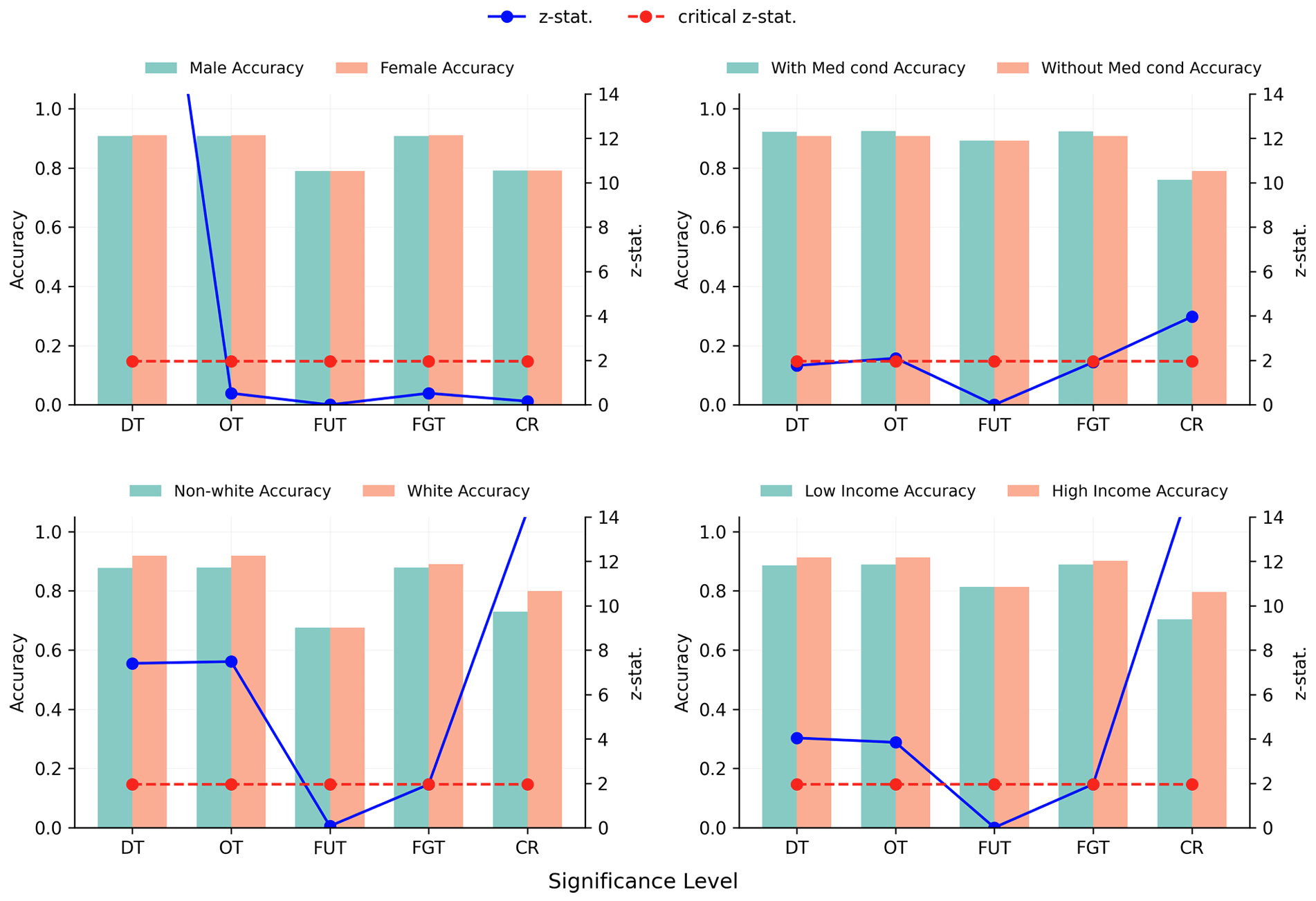
Extensive experiments using data from the 2017 National Household Travel Survey evaluate the computational performance of the proposed algorithms and the ability of the fair DL approach to provide provable and adaptable fairness guarantees for travel choice predictions. The exact solution method obtains optimal solutions across the tested instances, while the heuristic closely approximates these solutions with substantially lower computational burdens. The proposed method balances prediction accuracy and fairness, satisfying the practical equality constraints while maintaining relatively high accuracy. Adjusting the significance level allows the method to accommodate different fairness standards, with stricter standards reducing accuracy gaps between groups. This study offers a flexible and theoretically robust solution to fairness in travel choice prediction, with potential applications for enhancing equity in transportation systems.
Research Products
- Chen, Z., Xu, Y., and Peeta, S. (2025). Deep learning-based travel choice prediction with provable and adaptable fairness guarantees. Transportation Research Part B: Methodological, 200, 103318.
- Xu, Y., Chen, Z., and Peeta, S. An integrated knowledge distillation and federated approach for fair travel choice prediction. Working paper.