LLM as Choice Modeler
Developing a choice model requires numerous decisions about its specification, estimation, and interpretation. Our research investigates how Large Language Models (LLMs) can support this process through human–AI collaboration, using their methodological knowledge and reasoning capabilities to develop explicit, task-specific choice models under human guidance.
LLM as Travel Choice Modeler
This study asks whether an LLM should directly predict choices from explanatory variables or instead construct and estimate a model that produces those predictions. We unify existing LLM-based approaches for choice modeling into an “LLM-as-choice-predictor” paradigm because they all use the LLM to map a textual description of a traveler and choice scenario directly to a predicted choice. We propose an alternative “LLM-as-choice-modeler” paradigm, where the LLM constructs the specification of a choice model, estimates it using observed choices, applies it to new observations, and interprets its predictions. The resulting model, not the LLM’s internal reasoning, maps explanatory variables to choice probabilities. As shown in Figure 1, we implement the proposed paradigm as a four-agent framework for model construction, optimization, prediction and analysis, and explanation. The Model Construction Agent generates executable model code based on the prediction task, dataset schema, and researcher-provided constraints. The Model Optimization Agent estimates the parameters using training data and selects the model using validation data. The Prediction and Analysis Agent applies the estimated model to new observations and computes interpretation measures such as marginal effects and elasticities. The Explanation Agent then translates these measures into behavioral explanations grounded in the estimated model, rather than freely rationalizing a predicted choice after the fact.

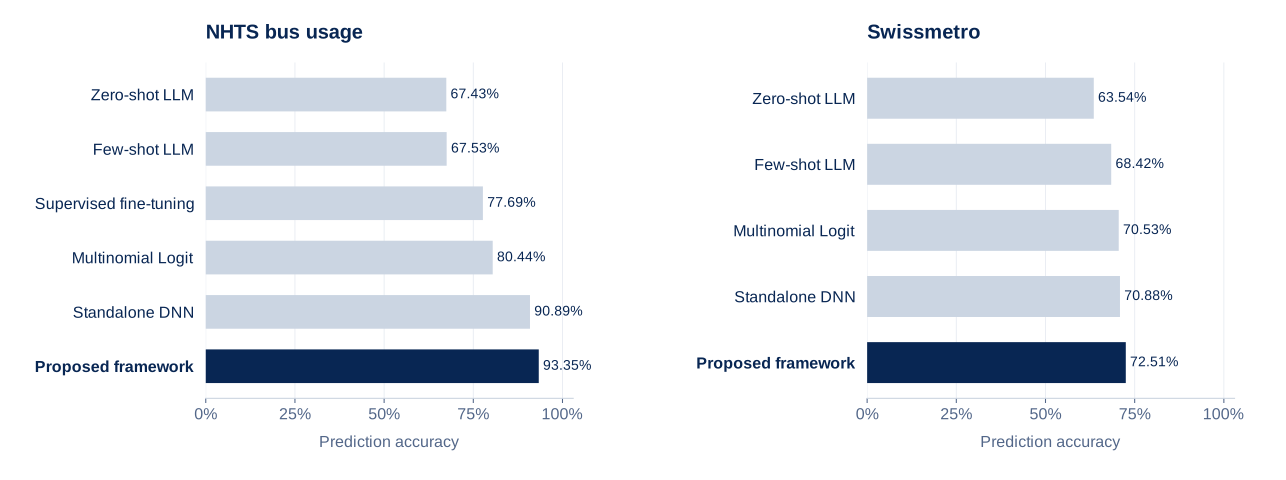
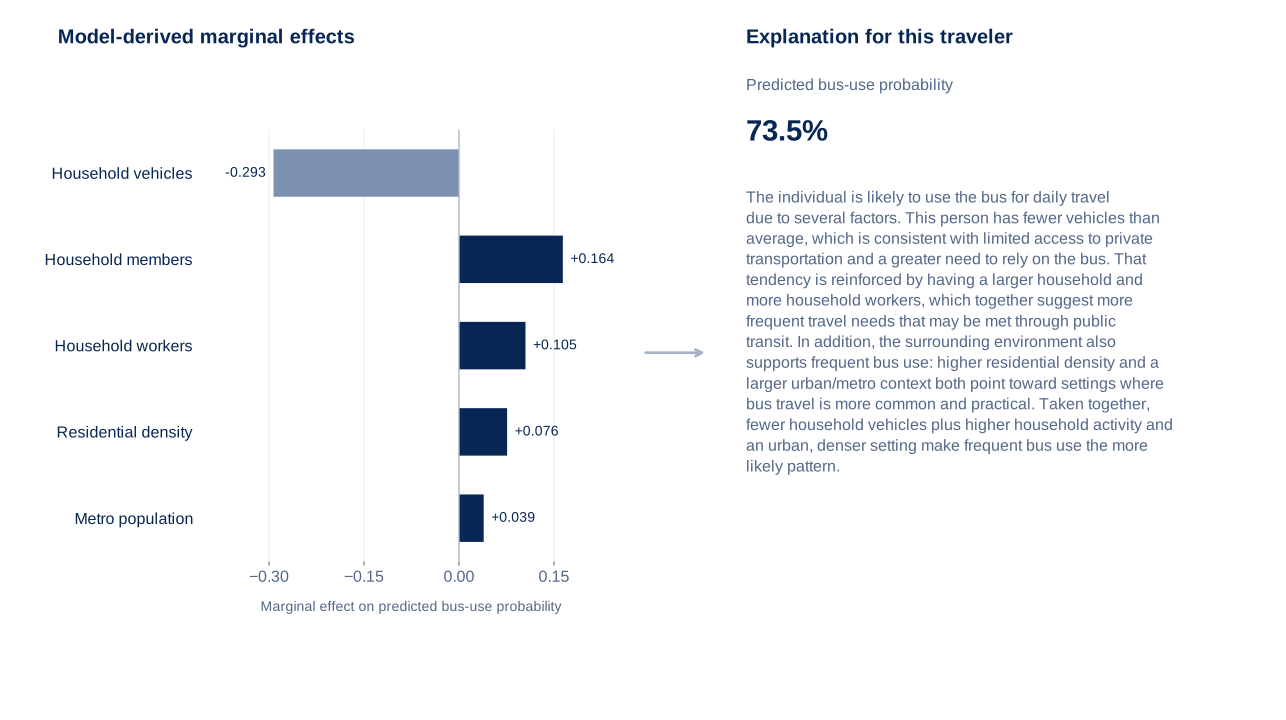
The framework is evaluated on the U.S. National Household Travel Survey dataset with 80,262 observations and the Swissmetro dataset with 9,036 observations. As shown in Figure 2, it achieves prediction accuracies of 93.35% and 72.51%, respectively, exceeding the reported accuracies of the compared direct LLM approaches, Multinomial Logit, and standalone DNN models. The accuracy improvement is larger on NHTS and more modest on Swissmetro. Figure 3 illustrates an individual-level behavioral explanation grounded in model-derived sensitivity measures. For this traveler, the framework explains the predicted likelihood of bus use through household vehicle ownership, household size, the number of workers, residential density, and metropolitan area size.
Research Products
- Xu, Y., Chen, Z., and Peeta, S. LLM as Travel Choice Modeler. Accepted for presentation at the 2027 TRB Annual Meeting; manuscript under journal review.