Modular Automated Transportation
The asymmetry between transportation demand and supply is responsible for most problems compromising the quality of life in modern society, such as traffic congestion and energy crisis. Typical solutions to these issues are expanding transportation infrastructure (e.g., building more roads) and managing traffic demand (e.g., congestion pricing). Although vehicles hold great potential in balancing the demand-supply asymmetry, they are generally overlooked. We propose to design a next-generation transportation system with the emerging Modular Automated Vehicle (MAV) technologies, where vehicles dynamically adjust their capacities by managing the vehicle length to accommodate the highly fluctuating demand, as shown in Figure 1.
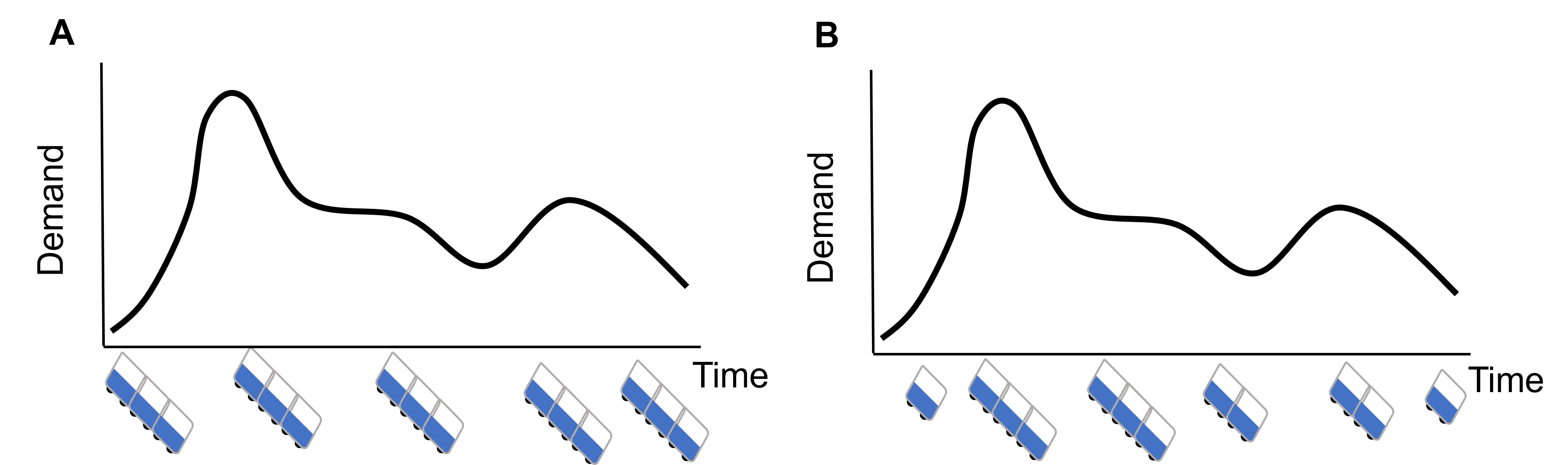
Figure 1. Existing fixed-capacity mobility systems (A) and proposed time-varying capacity systems (B)
We have investigated the operational design, energy implications, and congestion effects of the proposed MAV systems, which has resulted in a methodological framework for designing and analyzing MAV systems and similar systems. To formulate the framework, we first investigated a basic system component (e.g., a local time neighborhood) that often yields elegant analytical properties on the (near-) optimal system design. Analytical insights from the basic system component were then applied to develop scalable computational tools (e.g., optimization models and approximation methods) to efficiently design a (near-) optimal MAV system in various mobility applications, such as shuttle systems, corridor systems, shared-use corridors, highway networks, and airport baggage transportation. Results revealed the necessity to use time-varying capacity operations to improve the performance of mobility systems (for example, Figure 2). In these works, we also conducted extensive experiments to assess the computational tractability of the proposed methods as well as the energy implications and congestion effects of the MAV systems.
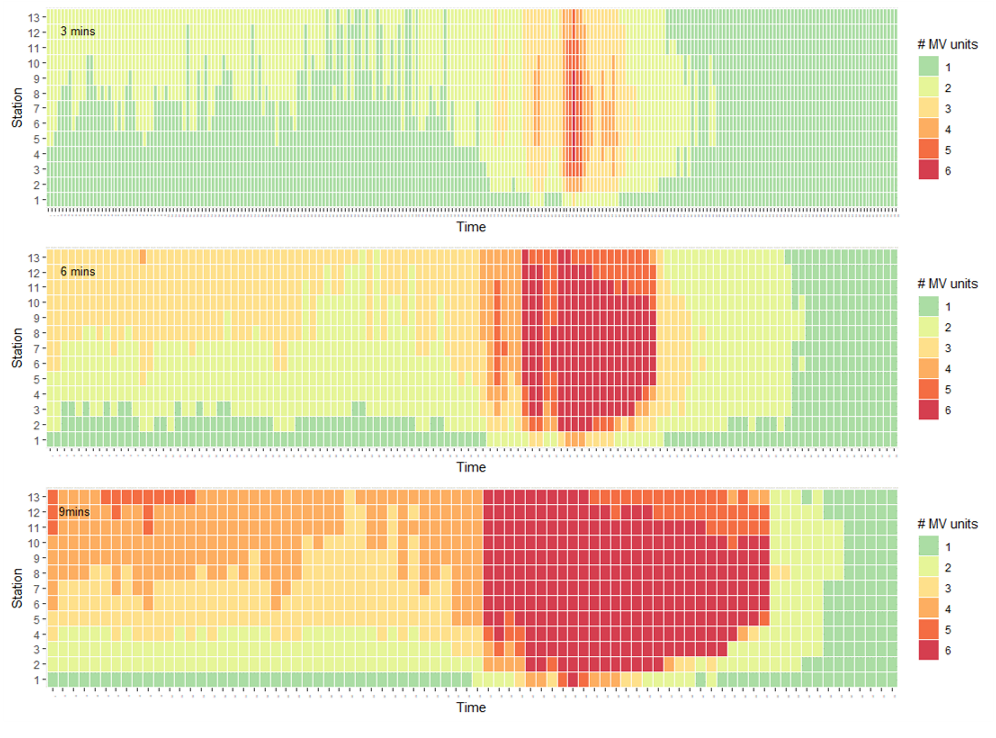
Figure 2. Optimal system design for a train corridor in the Beijing Metro system.
Research Products
- Cui, X., Li, Z., and Chen, Z. (2026). An exact approach model for designing modular automated transit shuttle systems with passenger flow control. Under review.
- Cui, X., and Chen, Z. (2025). A continuous model for designing modular automated transit shuttle systems with passenger flow control. Under review.
- Shi, X., Chen, Z., Li, X., and Qu, X. (2024). Modular vehicles can reduce greenhouse gas emissions for departure flight baggage transportation. Journal of Air Transport Management, 119, 102633.
- Chen, Z., Li, X., and Qu, X. (2022). A continuous model for designing corridor systems with modular autonomous vehicles enabling station-wise docking. Transportation Science, 56(1), 1–30.
- Gong, M., Hu, Y., Chen, Z., and Li, X. (2021). Transfer-based customized modular bus system design with passenger-route assignment optimization. Transportation Research Part E: Logistics and Transportation Review, 153, 102422.
- Chen, Z., and Li, X. (2021). Designing corridor systems with modular autonomous vehicles enabling station-wise docking: Discrete modeling method. Transportation Research Part E: Logistics and Transportation Review, 152, 102388.
- Pei, M., Lin, P., Du, J., Li, X., and Chen, Z. (2021). Vehicle dispatching in modular transit networks: A mixed-integer nonlinear programming model. Transportation Research Part E: Logistics and Transportation Review, 147, 102240.
- Shi, X., Chen, Z., Pei, M., and Li, X. (2020). Variable-capacity operations with modular transits for shared-use corridors. Transportation Research Record, 2674(9), 230–244.
- Chen, Z., Li, X., and Zhou, X. (2020). Operational design for shuttle systems with modular vehicles under oversaturated traffic: Continuous modeling method. Transportation Research Part B: Methodological, 132, 76–100.
- Chen, Z., Li, X., and Zhou, X. (2019). Operational design for shuttle systems with modular vehicles under oversaturated traffic: Discrete modeling method. Transportation Research Part B: Methodological, 122, 1–19.