Motion Planning
Vehicle motion planning designs the space-time trajectories of automated vehicles, accounting for surrounding traffic, safety, and passenger comfort. Our research investigates longitudinal car-following and lateral lane-changing trajectories that account for interactions among multiple road users. We also investigate how contextual reasoning can support automated driving when human behavior is ambiguous.
Car Following
Conventional car-following models for human-driven vehicles typically describe a vehicle’s response to the vehicle immediately ahead. Connected and Automated Vehicles (CAVs), however, can obtain information from multiple vehicles ahead and use it to better plan their motion. We develop a multiple-factors-aware car-following model that considers the speeds, speed differences, and headways of several preceding vehicles. The study combines theoretical stability analysis with simulation to examine how these interactions affect vehicle movements and traffic performance. Figure 1 compares fleet velocity profiles from the proposed model and three benchmark models at four simulation times, illustrating differences in speed stability across the fleet. Related work develops a bi-scale calibration method for car-following models using both microscopic measurements, such as individual vehicle acceleration, and macroscopic measurements, such as corridor-level travel time and fuel consumption. This approach connects individual vehicle behavior with system-level outcomes and helps reduce the effects of noisy trajectory measurements on model calibration.

Lane Changing
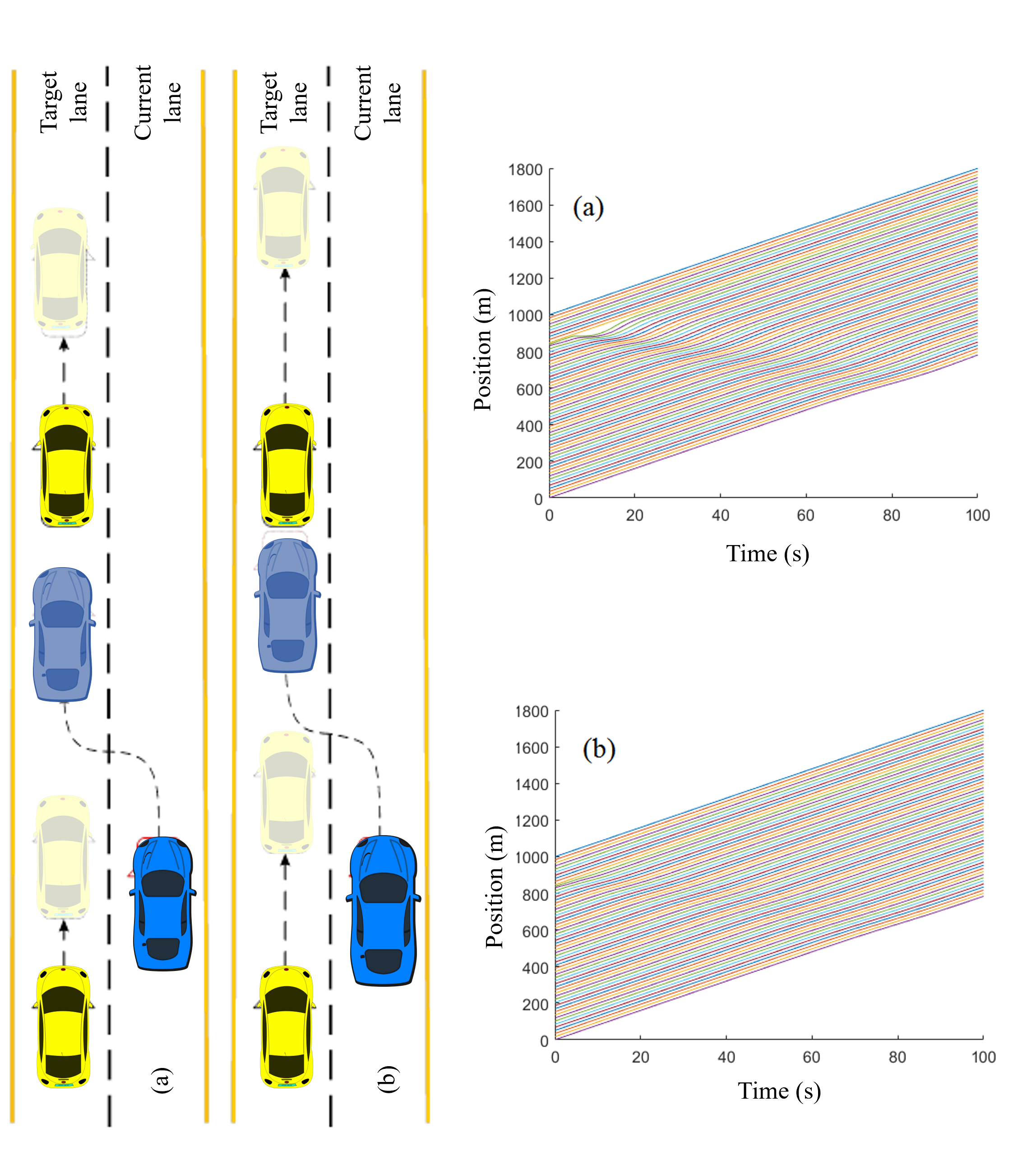
Connected and Autonomous Vehicle (CAV) technologies offer opportunities to coordinate lane-changing maneuvers and reduce their disruption to surrounding traffic. Existing studies often focus on planning the movement of a Subject Vehicle (SV), assuming that a vehicle in the target lane must decelerate to create a safe gap. We investigate whether jointly planning the trajectories of the SV and surrounding vehicles—and allowing a preceding vehicle in the target lane to accelerate—can improve this process. As illustrated in Figure 2, we develop a dynamic cooperative lane-changing model that updates decisions in real time through three steps: lane-changing decision-making, cooperative trajectory planning, and trajectory tracking. A linearized vehicle kinematic model accounts for vehicle states, minimum safety distances, and passenger comfort when determining feasible maneuvers. The model then coordinates longitudinal and lateral trajectories for the vehicles involved. Numerical simulations show increased lane-changing success rates and smoother trajectories for the SV and upstream vehicles, at the cost of slightly greater oscillations for the last downstream vehicle. Overall, the model reduces the negative effects of lane changing on surrounding traffic. Additional experiments varying key input parameters demonstrate the robustness of these findings.
Neurosymbolic Planning in Mixed Traffic
Human road users can communicate intent implicitly and may depart from formal rules while maintaining informal coordination. Supported by Drexel’s School of Engineering through the Grimes Family Faculty Award, our ongoing research investigates neurosymbolic learning for safe autonomous driving under ambiguous trust. We aim to combine contextual reasoning with vehicle planning and control to reduce unnecessarily conservative behavior while maintaining safety. The work is led by Dr. Zhiwei Chen with Dr. Li Zhang.
Research Products
- Long, K., Shi, H., Chen, Z., Liang, Z., Li, X., and Souza, F. (2024). Bi-scale car-following model calibration based on corridor-level trajectory. Transportation Research Part E: Logistics and Transportation Review, 186, 103497.
- Ma, H., Wu, H., Hu, Y., Chen, Z., and Luo, J. (2022). Multiple-factors aware car-following model for connected and autonomous vehicles. Transportation Research Record, 2676(2), 649–662.
- Li, Q., Chen, Z., and Li, X. (2022). Review of connected and automated vehicle platoon merging and splitting operations. IEEE Transactions on Intelligent Transportation Systems, 23(12), 22790–22806.
- Wang, Z., Zhao, X., Chen, Z., and Li, X. (2021). A dynamic cooperative lane-changing model for connected and autonomous vehicles with possible accelerations of a preceding vehicle. Expert Systems with Applications, 173, 114675.