Trajectory Control
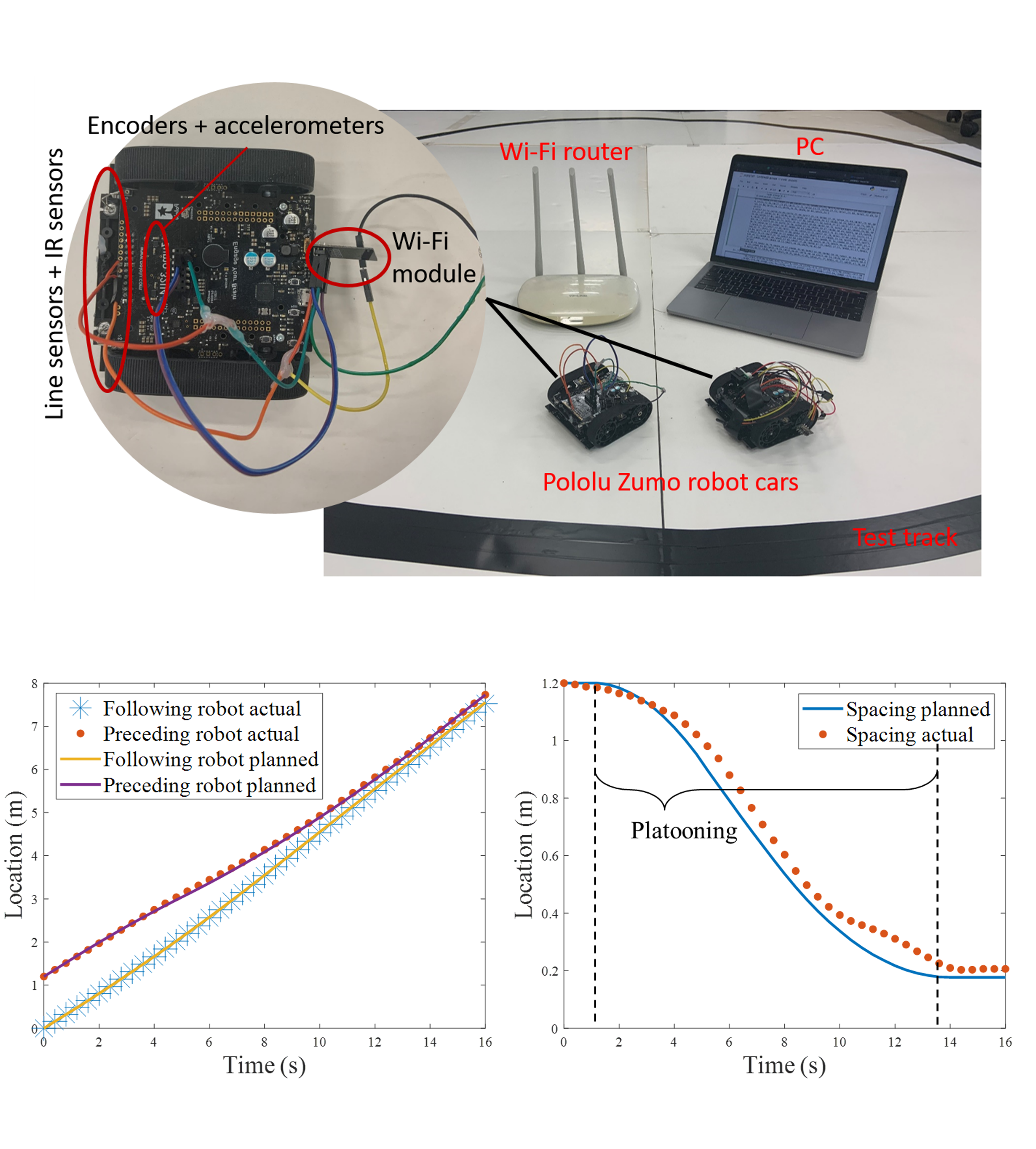
Figure 1. Test bed (top row) and control performance (bottom row).
Motivated by the promising benefits of Connected and Autonomous Vehicles (CAVs) in improving fuel efficiency, mitigating congestion, and enhancing safety, numerous theoretical models have been proposed to plan CAV multiple-step trajectories (time-specific speed and location trajectories) to accomplish various operations. However, limited efforts have been made to develop proper trajectory control techniques to regulate vehicle movements to follow multiple-step trajectories and test the performance of theoretical trajectory planning models with field experiments. Without an effective control method, it is difficult to harvest the benefits of theoretical models for CAV trajectory planning.
This study proposed an online learning-based model predictive vehicle trajectory control structure to follow time-specific speed and location profiles. Unlike single-step controllers that are dominantly used in the literature, a multiple-step model predictive controller is adopted to control the vehicle’s longitudinal speed for higher accuracy. The model predictive controller output (speed) cannot be interpreted by vehicles. A reinforcement learning agent is used to dynamically convert the speed value to the vehicle’s direct control variable (i.e., throttle/brake). The reinforcement learning agent captures real-time changes in the operating environment. This is valuable in saving engine parameter calibration resources and improving the trajectory control accuracy. A line tracking controller keeps vehicles on track by regulating the lateral motions. As shown in Figure 1, the proposed control structure is tested using reduced-scale robot cars. The adaptivity of the proposed control structure is demonstrated by changing the vehicle load. Then, experiments on two fundamental CAV platoon operations (i.e., platooning and split) show the effectiveness of the proposed trajectory control structure in regulating robot movements to follow time-specific reference trajectories against a benchmark.
Experimental Platforms
Our experimental research connects vehicle models with the constraints of physical systems. Dr. Chen’s earlier collaborative work at the University of South Florida included full-scale automated vehicle testbeds and field testing. At Drexel, we are developing an independent experimental program using F1TENTH robotic vehicles and a full-scale automated vehicle. These platforms support the translation of prediction, planning, and control methods from simulation to physical experiments.
Research Products
- Li, Q., Zhang, P., Yao, H., Chen, Z., and Li, X. (2024). Online learning-based model predictive trajectory control for connected and autonomous vehicles: Modeling and physical tests. Journal of Intelligent and Connected Vehicles, 7(2), 86–96.