Distributional Impact Evaluation
Transportation technologies and services can improve mobility while distributing benefits and burdens unevenly across travelers. Our research develops disaggregated methods for distributional impact evaluation using individual-level data generated through large-scale agent-based simulation. These methods examine differences in accessibility, mobility, and affordability among individuals and population groups. Applications include bike-sharing in southern Tampa and automated vehicle systems in the Tampa Bay region.
Evaluating Bike-Sharing Impacts
The rising adoption of bike-sharing systems brings significant benefits to individuals and society as a whole. However, how these benefits are distributed among individual travelers and population groups remains an important question. At the first stage of this project, we proposed a methodological framework for evaluating the distributional impacts of bike-sharing systems, with Coast Bike Share system in southern Tampa as a case study. The framework integrates three different datasets: bike-sharing infrastructure, individual travel itineraries and individual sociodemographic attribute data. With these datasets, we model individual accessibility to activity locations using bike-sharing as the mode of transportation by analyzing the “walking-cycling-walking” process of a bike-sharing trip and the trip-chaining behavior in individual travel itineraries. Further, a series of measures are used to analyze the distribution of accessibility from the perspective of both horizontal and vertical equity. To assess horizontal equity, we apply the Lorenz curve, Gini index and mapped geographic differences. For vertical equity, we compare descriptive statistics by group, perform analysis of variance, and calculate the subgroup inequality index using disaggregated data. Results reveal that accessibility to bike-sharing is not evenly distributed among individuals in the population, within the geographic space, and among different sociodemographic groups of southern Tampa, as shown in Figure 1. Further, our results also highlight the need to incorporate high-resolution disaggregated data and tour-based analysis to evaluate the distributional impacts of bike-sharing systems.
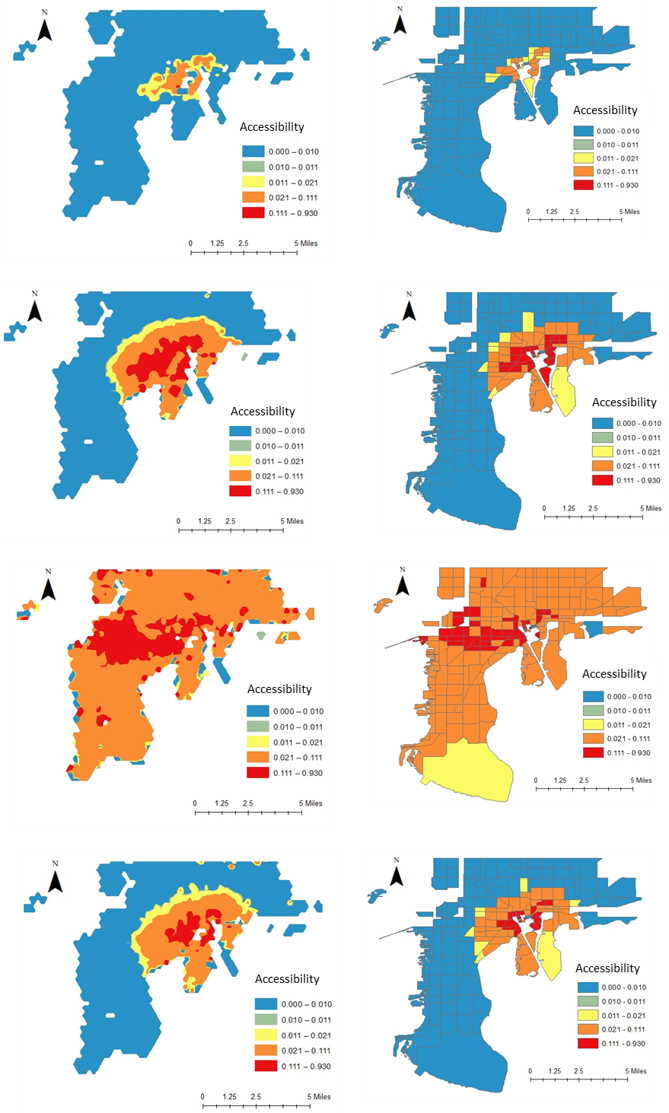
At the second stage of this project, we investigated whether there is unobserved heterogeneity in the distribution of transportation outcomes. To this end, we carried out an empirical study focusing on the distribution of individual accessibility to activity locations via bike-sharing in southern Tampa. A disaggregated dataset containing information on individual bike-sharing accessibility and socio-economic factors is modeled with a random parameters logit model that allows for the investigation of possible unobserved heterogeneity. Further, models are estimated using data aggregated to parcel- and TAZ- levels to explore the impacts of data aggregation on model estimation results. The models unveil the unobserved heterogeneity in bike-sharing accessibility among populations in different groups defined by different sociodemographic factors in southern Tampa. These results shed insights into how the inconsistent disparity direction of transportation outcomes across individuals in a population group can be measured from the heterogeneity effects. Finally, a comparison between different models show that to capture such inconsistency, the use of disaggregated data with heterogeneity models is highly recommended for distributional impact evaluation.
Evaluating Automated Vehicle Impacts
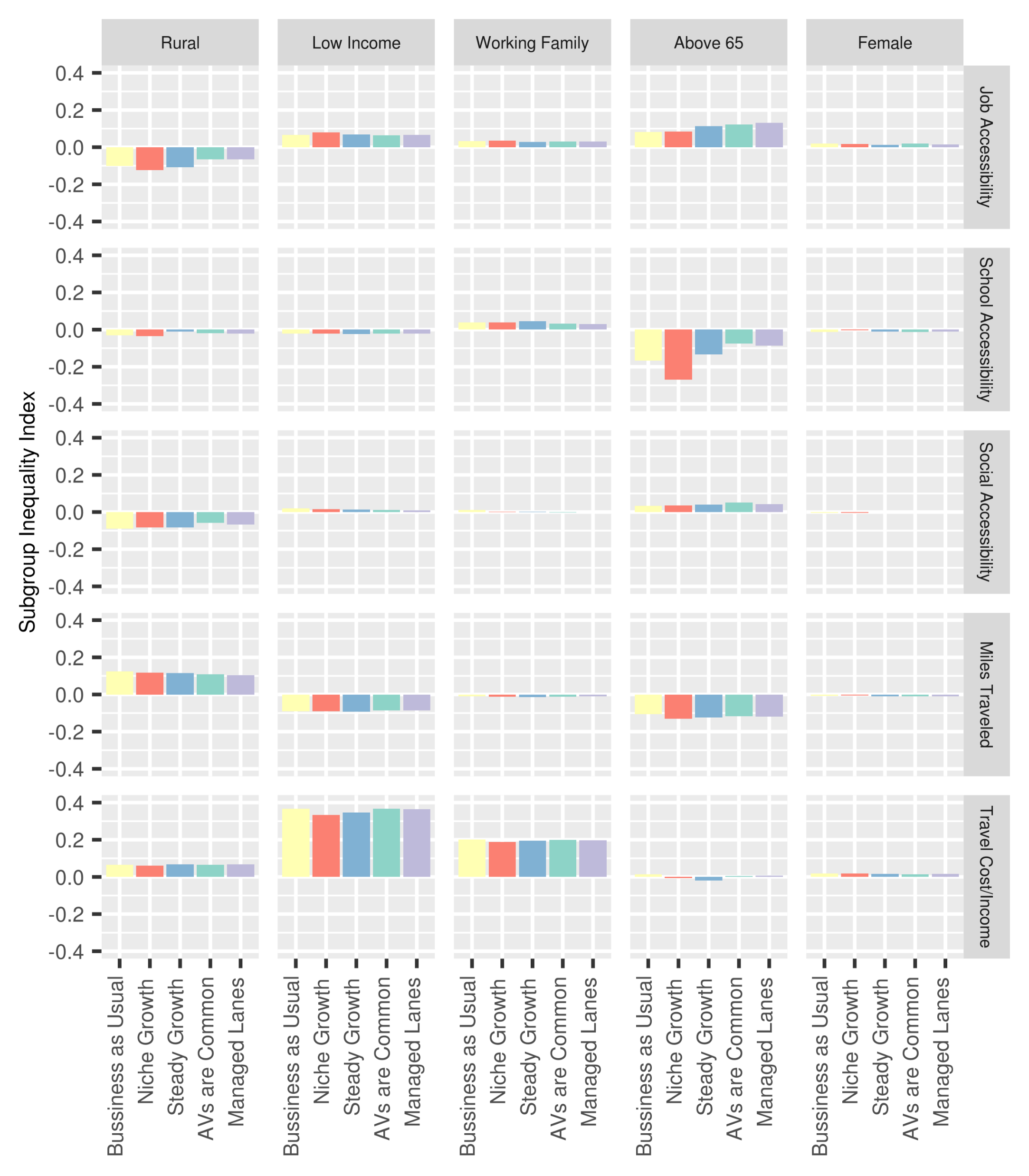
The distributional impacts of Automated Vehicles (AVs) are an important public policy issue, raising questions about who benefits and who bears the burdens as the technology is introduced. The goal of this project was to develop a modeling framework to support distributional impact assessments before AV systems are widely deployed. We aimed to characterize the impacts of AVs on accessibility, mobility, affordability, and the associated distributional impacts for system users. Here, we propose an innovative disaggregated modeling framework that integrates agent-based simulation, a series of transportation outcome metrics, and distributional analysis methods. This framework utilizes individual-level data to more-accurately capture individual disparities in transportation outcomes. It also extends a state-of-the-art multi-agent traffic simulation model — MATSim — to simultaneously simulate privately-owned and shared AVs. To test the applicability of the proposed modeling framework, a case study was conducted in the Tampa Bay region. Five scenarios were considered with different market shares of AVs and integration strategies based on a previous scenario planning study by the Federal Highway Administration. All scenarios were consistent with the existing transportation system structure where privately-owned vehicles dominate the vehicle fleet.
Results reveal that when the market share of AVs was low, the overall performance of the transportation system deteriorated, and the distribution of accessibility and affordability became slightly more uneven among the population and between different population subgroups. Only when the market share of AVs reached a threshold level did the system start to increase accessibility, mobility, and affordability. However, the impact of AVs on the overall performance, horizontal equity, and vertical equity were all limited at low penetration rates. More equitable distributions of transportation outcomes were observed only at high AV penetration rates. This result suggests that AVs may reproduce existing disparities if the fundamental structure of the transportation system remains the same as today.
Research Products
- Chen, Z., Stuart, A. L., Guo, Y., Zhang, Y., and Li, X. (2024). Distributional equity impacts of automated vehicles: A disaggregated approach. Transportation Research Part C: Emerging Technologies, 167, 104828.
- Chen, Z., and Li, X. (2021). Unobserved heterogeneity in transportation equity analysis: Evidence from a bike-sharing system in southern Tampa. Journal of Transport Geography, 91, 102956.
- Guo, Y., Chen, Z., Stuart, A., Li, X., and Zhang, Y. (2020). A systematic overview of transportation equity in terms of accessibility, traffic emissions, and safety outcomes: from conventional to emerging technologies. Transportation Research Interdisciplinary Perspectives, 4, 100091.
- Chen, Z., Guo, Y., Stuart, A. L., Zhang, Y., and Li, X. (2019). Exploring the equity performance of bike-sharing systems with disaggregated data: A story of southern Tampa. Transportation Research Part A: Policy and Practice, 130, 529–545.