Transportation Network Design
Transportation networks connect people with the places and services they need. Our research develops optimization models for choosing where to locate facilities, how to connect them, and how to serve travelers within resource and operational constraints. The studies below examine customized bus networks, electric bicycle sharing, and surplus food delivery, connecting network design with traveler responses, vehicle capabilities, and community needs.
Customized Bus Networks
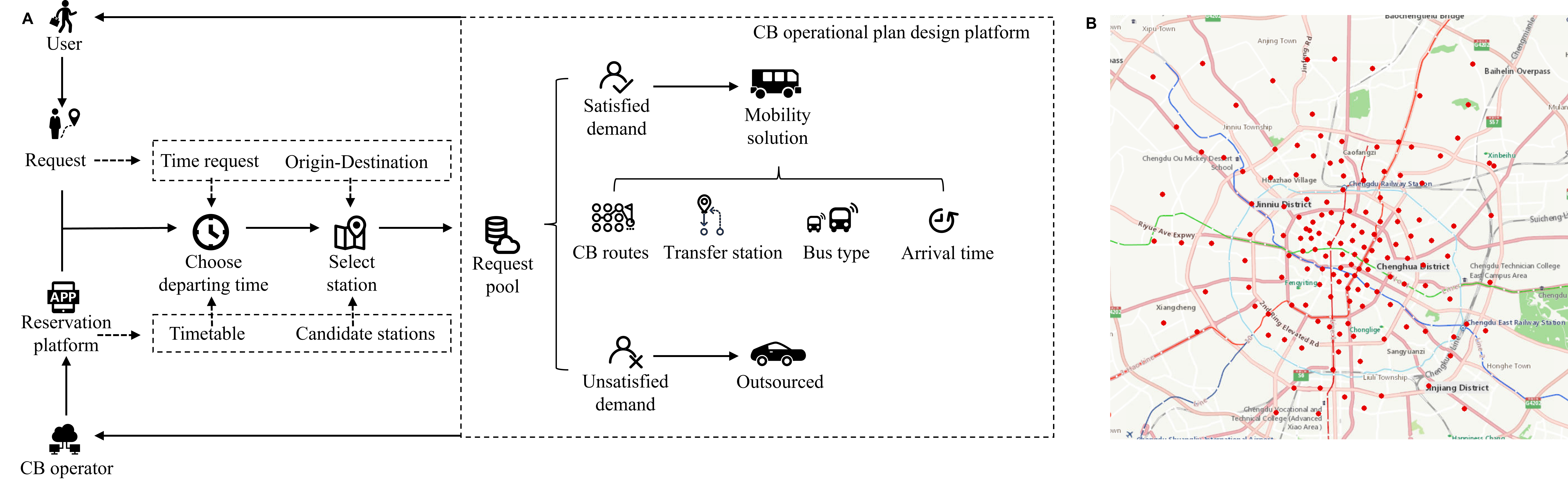
Figure 1. CB operational network design process (A) and case study area (B)
Customized Bus (CB) is an increasingly popular mode of transportation in many cities around the world. However, studies on CB network design have mostly overlooked three options that may further improve system performance: passenger-route assignment, passenger transfer, and modular vehicles. To bridge this gap, we propose to design a transfer-based CB network with a modular fleet while simultaneously optimizing the passenger-route assignment. To solve the optimal network structure with this new design paradigm, we formulate the network design problem into a nonlinear mixed integer optimization model. A linearization approach and a Particle Swarm Optimization (PSO) algorithm are proposed to solve the exact and near-optimal solution(s) to the model, respectively. Numerical experiments are conducted on the Sioux Falls network and a large-scale network in Chengdu, China. Results show that the customized PSO algorithm efficiently provides high quality near-optimal solutions compared with CPLEX, the genetic algorithm, and the simulated annealing algorithm. Results also show that incorporating passenger-route assignment optimization and the transfer operation produces a more cost-effective CB operational network with less operational costs and higher service quality. The benefit increases as the passenger demand grows.
E-Bike Sharing Station Planning
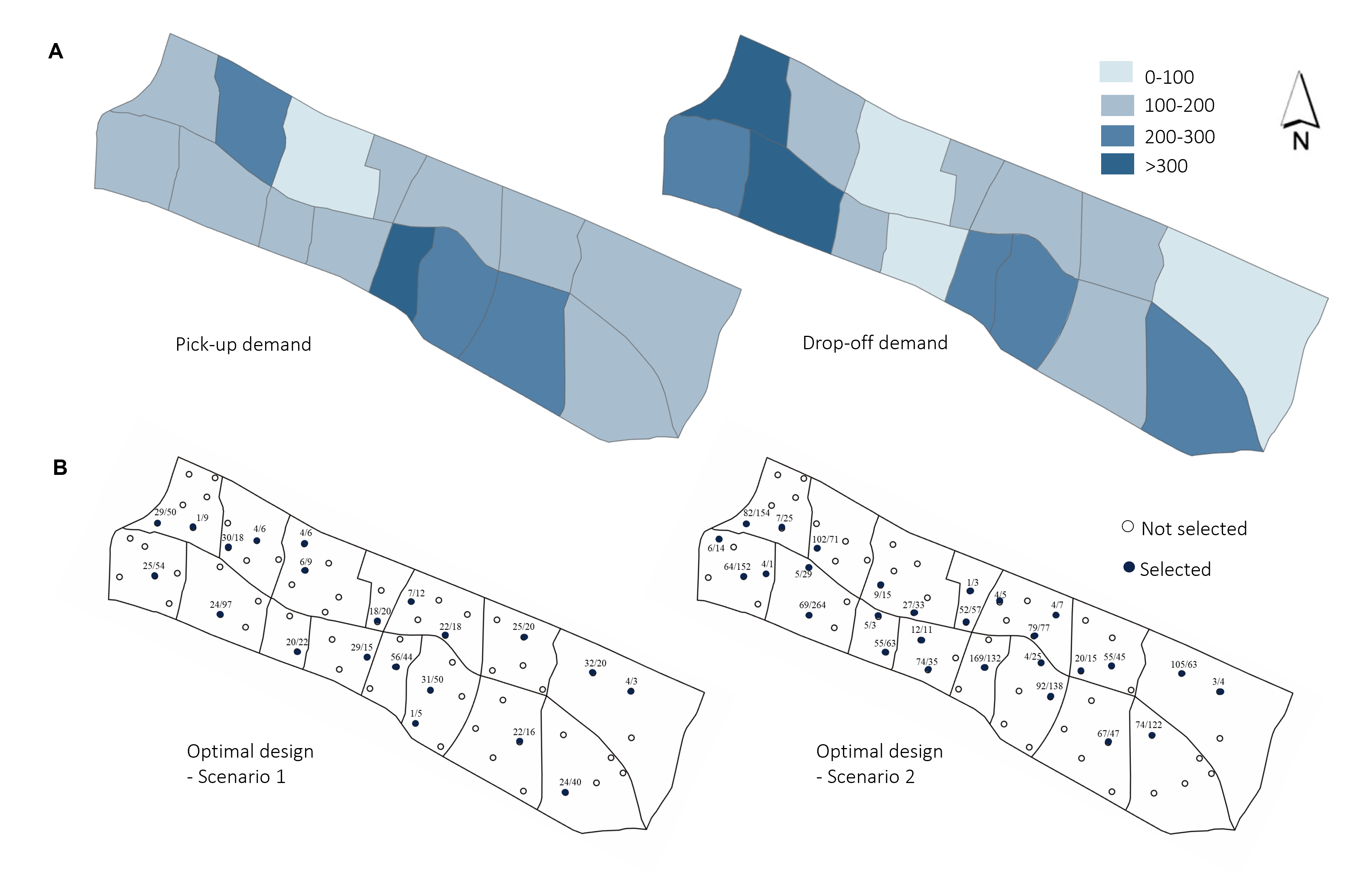
Figure 2. Travel demand (A) and optimal e-bike sharing network (B) in Guangzhou, China.
Electric bicycle sharing extends the range of conventional bike sharing, but charging requirements introduce additional challenges for station planning and operations. We study where to locate stations and how many e-bikes and charging piles to provide, accounting for how travelers respond to alternative deployment schemes. For a one-way, station-based system, we measure trip costs through travel time and delays at stations. We represent e-bike pickup and return as two queues affected by charging requirements and model traffic flow along routes. These components form a bi-level optimization model that connects system-level station deployment decisions with individual travelers’ choices. We establish the uniqueness of the solution, reformulate the bi-level model as a single-level mixed-integer program, and develop a hybrid particle swarm optimization algorithm to solve it. Numerical experiments evaluate the model and algorithm and provide insights into system design. In particular, charging-related delays can make stations bottlenecks in the network, highlighting the potential of quick-charging technologies and reservation policies to reduce system costs.
Food Distribution Network Design
Delivering surplus food to older adults can improve food access, but the time and travel required can make home delivery difficult for nonprofit organizations and their volunteers. Supported by NSF’s Civic Innovation Challenge (CIVIC), this project investigates CORELADE, a collect–relay–deliver model that combines nonprofit vehicle fleets with volunteers’ personal vehicles. Strategically located relay stations connect food collection with neighborhood delivery, with the aim of reducing volunteers’ logistical burdens. Working with Sharing Excess, University Square Apartments, and ElderNet, the project brings together optimization, data analytics, behavioral research, and community engagement to investigate how collection and delivery networks can better align with volunteer capabilities and the needs of aging communities. The network design questions include where relay stations should be located and how collection and delivery activities should be coordinated to support efficient, equitable, and financially sustainable service.
Research Products
- Gong, M., Hu, Y., Chen, Z., and Li, X. (2021). Transfer-based customized modular bus system design with passenger-route assignment optimization. Transportation Research Part E: Logistics and Transportation Review, 153, 102422.
- Chen, Z., Hu, Y., Li, J., and Wu, X. (2020). Optimal deployment of electric bicycle sharing stations: Model formulation and solution technique. Networks and Spatial Economics, 20(1), 99–136.