Transportation & Health
Transportation affects health through the environments people encounter, the activities they undertake, and the opportunities they can reach. This VIP project examines these connections to support the long-term goal of incorporating health considerations into transportation planning. Working across transportation engineering, environmental science, economics, and public health, students developed a framework of transportation–health pathways and reviewed quantitative health impact assessment models. The two student presentation reports document work completed in Spring and Fall 2023, with guidance from Drs. Zhiwei Chen, Shannon Capps, and Gina Lovasi.
Contributing Students
Manlin Gong (Civil Engineering); Andrea Eleazar (Public Health); Yernur Abdulin (Civil Engineering); Atara Saunders (Economics and Global Studies); Baden Stickley (Civil Engineering); Parker Sarge (Electrical Engineering); Sydney Eben (Environmental Science).
Transportation–Health Pathways
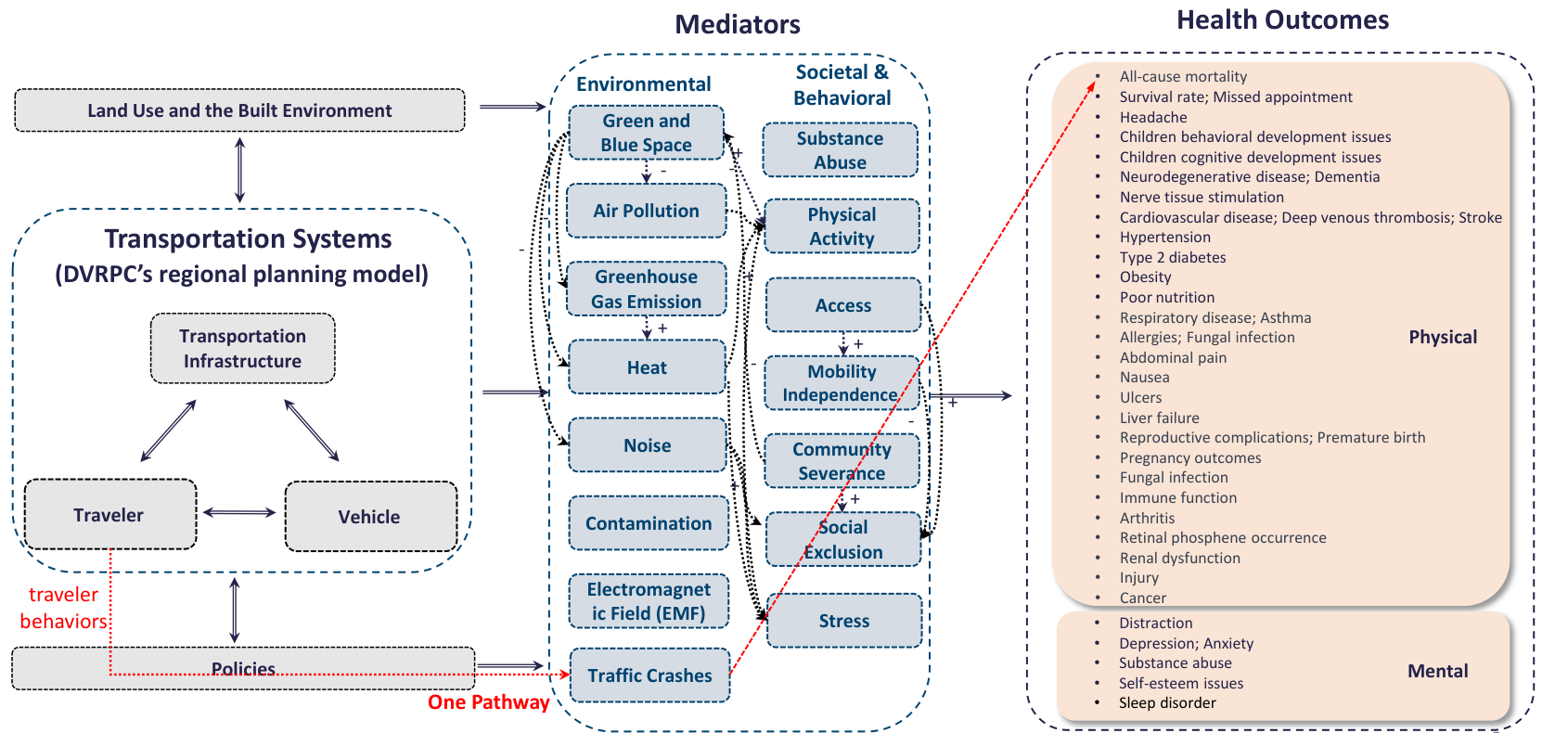
The Spring 2023 team reviewed the literature to connect transportation infrastructure, traveler behavior, vehicle use, and policies with physical and mental health outcomes. As shown in Figure 1, the resulting framework traces these connections through environmental and societal mediators, including air pollution, physical activity, traffic crashes, access, mobility independence, and community severance. The framework makes the range of potential health effects visible and provides a basis for examining which pathways existing assessment tools include or omit.
Health Impact Assessment Models
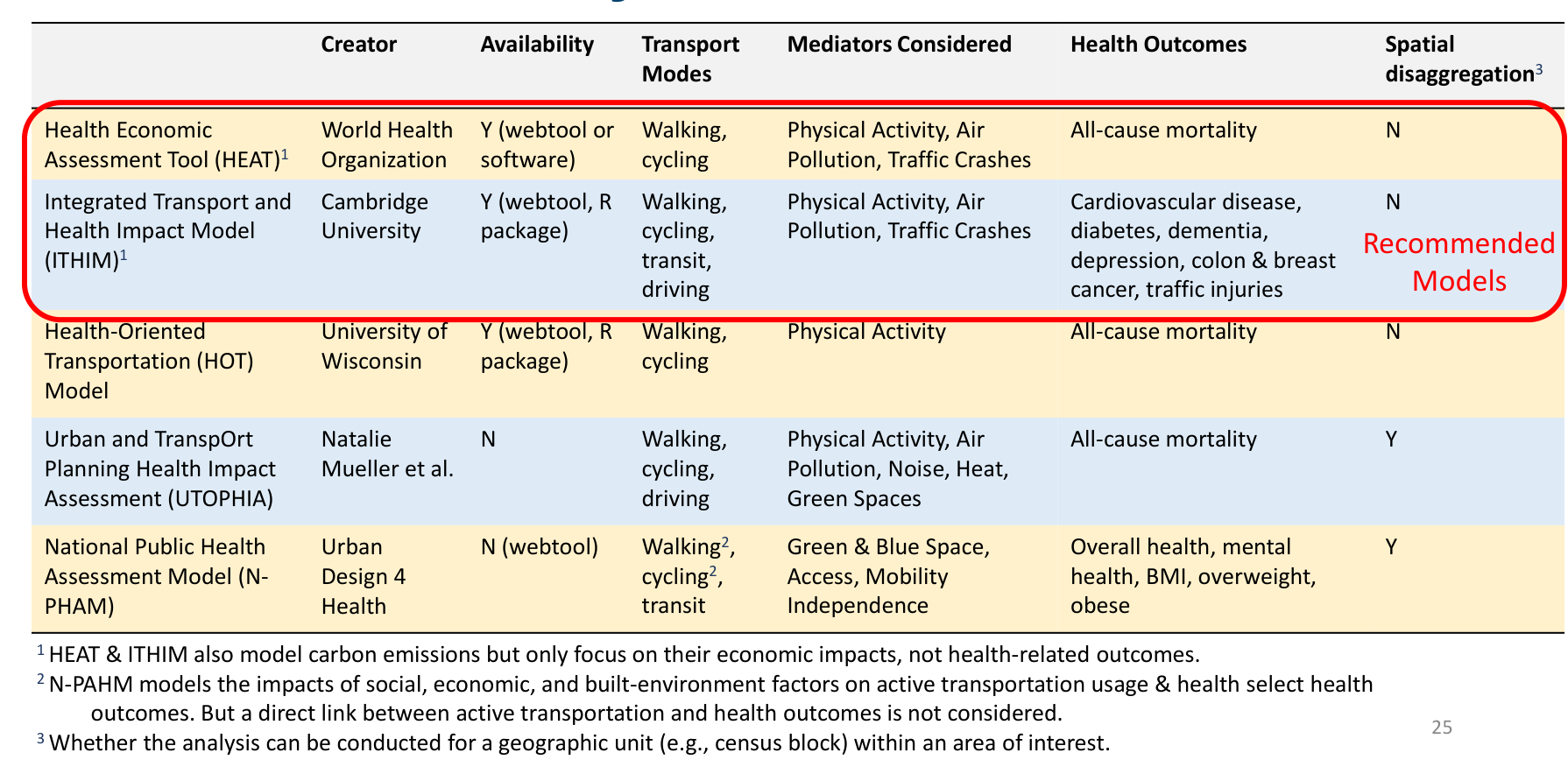
Building on the pathway review, the Fall 2023 team compared five quantitative models: the Health Economic Assessment Tool (HEAT), Integrated Transport and Health Impact Model (ITHIM), Health-Oriented Transportation (HOT) model, Urban and Transport Planning Health Impact Assessment (UTOPHIA), and National Public Health Assessment Model (N-PHAM). Students examined model availability, transportation modes, mediators, health outcomes, and spatial disaggregation, and used a scenario involving increased cycling in the Greater Philadelphia region to explore how the models could inform planning analysis. Their comparison, summarized in Figure 2, highlights differences in model scope and the need to examine assumptions and transferability before applying a model in a new setting.
Student Products
Transportation–Health Pathways — Spring 2023 presentation report (PDF)
Health Impact Assessment Models — Fall 2023 presentation report (PDF)