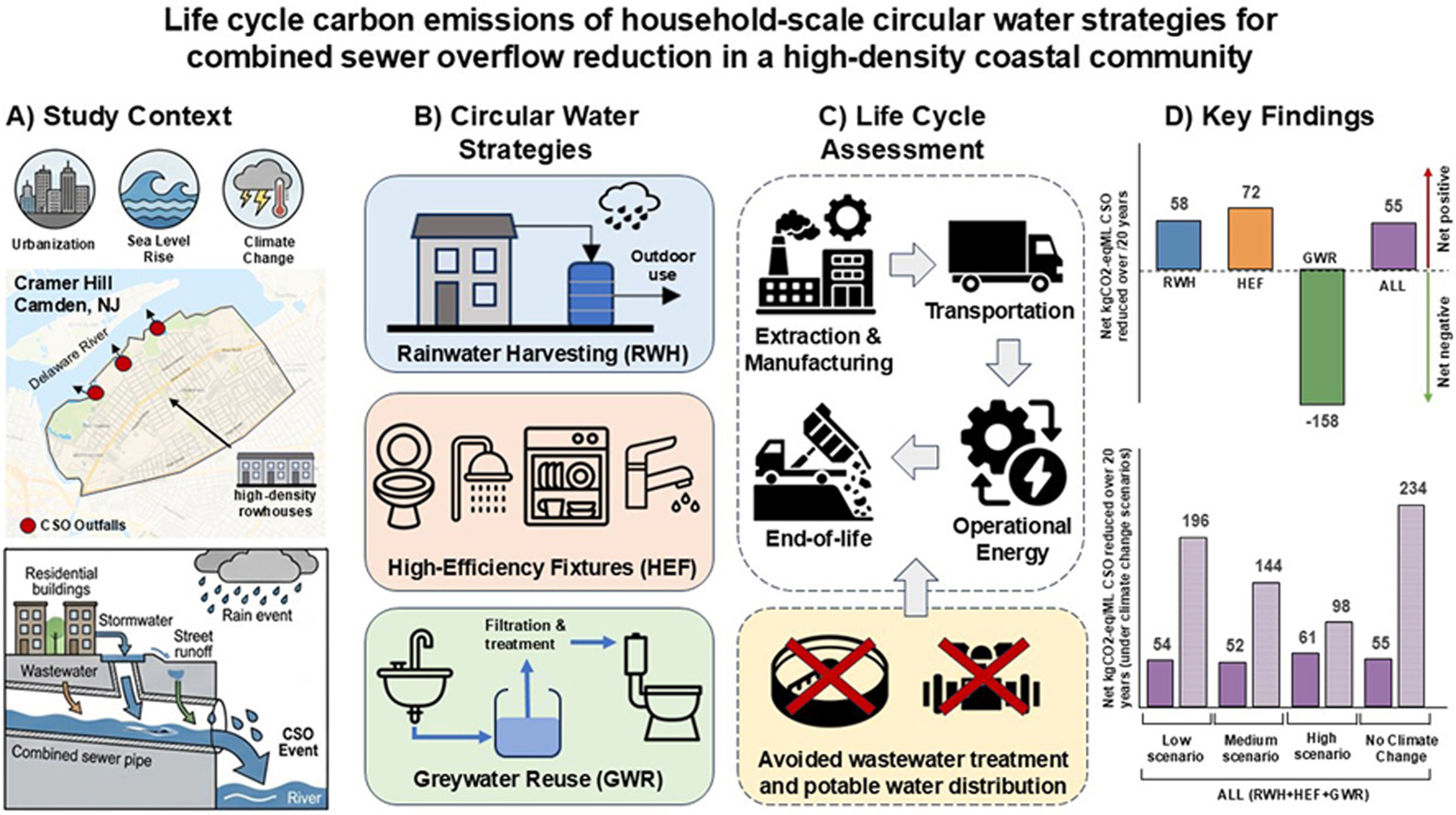
Aging combined sewer systems in the northeastern United States discharge billions of gallons of combined sewer overflow (CSO) annually, burdening coastal communities. The circular water economy framework promotes reduction, reuse, and recovery of water resources to enhance resilience and reduce environmental burdens through strategies such as rainwater harvesting (RWH), greywater reuse (GWR), and high-efficiency fixtures
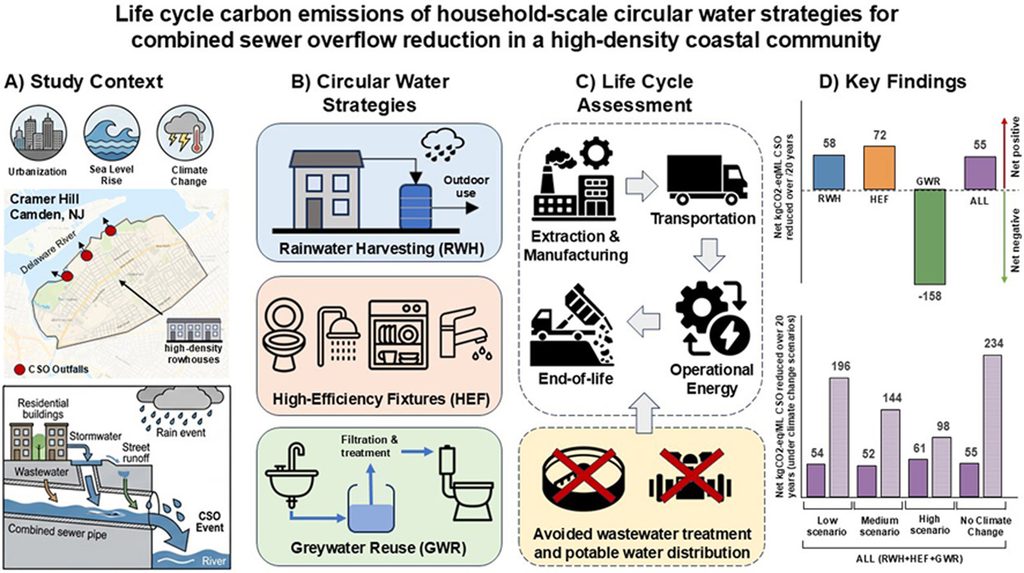
(HEF). A previous hydraulic network model quantified the potential of those strategies in reducing annual CSO and flood volume in a high-density coastal neighborhood in New Jersey. Building on this calibrated hydraulic model, this study couples LCA with outfall-level CSO and flood volumes, a functional unit not previously used to evaluate decentralized strategies, introducing a normalized metric that reveals environmental trade-offs conventional carbon payback analysis and commonly used functional units cannot capture. Under this metric, RWH, HEF, and the combination scenario range from +55.1 to +72.2 kg CO2-eq/ML CSO, a finding invisible to carbon payback analysis which yields results ranging from 23.6 years to timescales exceeding human planning horizons.
GWR had the highest carbon benefits, achieving net carbon savings of 158 kg CO2-eq/ML CSO and a carbon payback of 4.8 years. Strategy rankings shift substantially depending on whether the functional unit is normalized against CSO or flood reduction, and results indicate that GWR is preferable for carbon minimization, RWH for maximizing single-strategy hydraulic performance despite its narrow carbon accounting boundary, and the combined strategy for maximizing resilience under worsening climate conditions, with its carbon efficiency per unit of flood protection improving as climate stress increases.
Read full article here: https://doi-org.ezproxy2.library.drexel.edu/10.1016/j.clrc.2026.100494