
Jamming and other interference can cripple a wireless link, and in the field its parameters are rarely known in advance. DWSL is exploring how generative AI can learn interference directly from radio measurements and recreate it on demand, using plain-language text prompts as the controls.
Text-controlled interference synthesis
Our approach treats interference as an image-generation problem. Two software-defined radios (USRP N210s) record jamming signals over the air, either a tone or a chirp at low, medium, or high interference levels, and the receiver’s IQ samples are converted into spectrograms. We fine-tune Stable Diffusion XL, an open text-to-image model, on these spectrograms using DreamBooth and low-rank adaptation (LoRA), so that a prompt such as {chirp, low} or {tone, high} produces a new, realistic interference spectrogram.
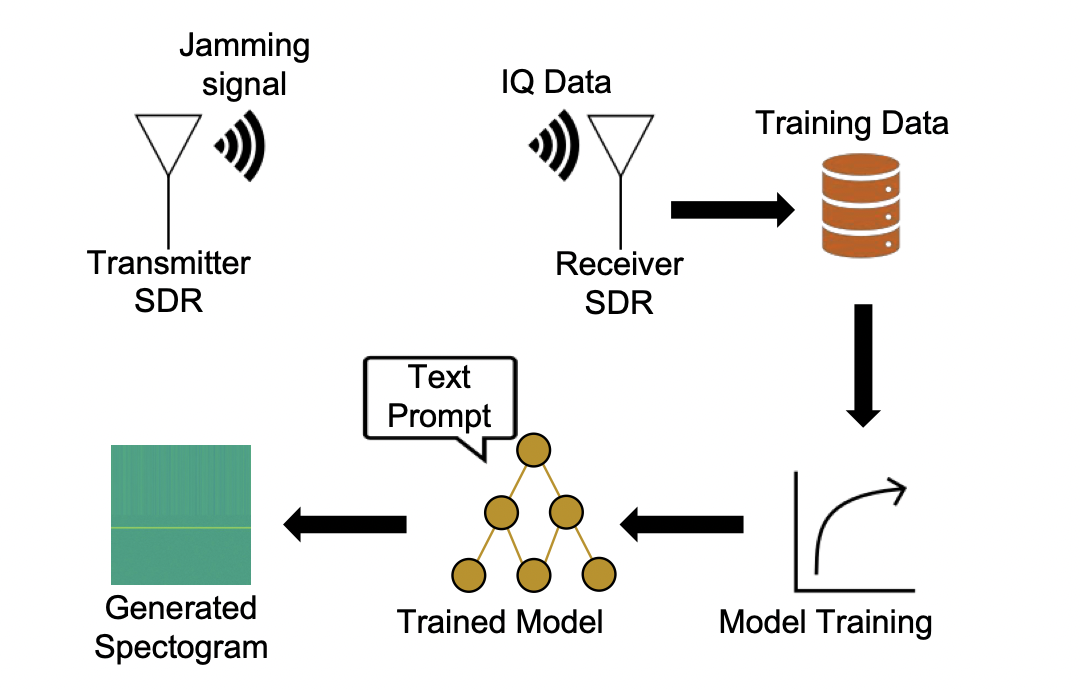
Unlike traditional interference models, which rely on predefined signal models, this approach needs no prior knowledge of the jammer’s parameters or the transmitted signal: it learns from labeled measurements alone.
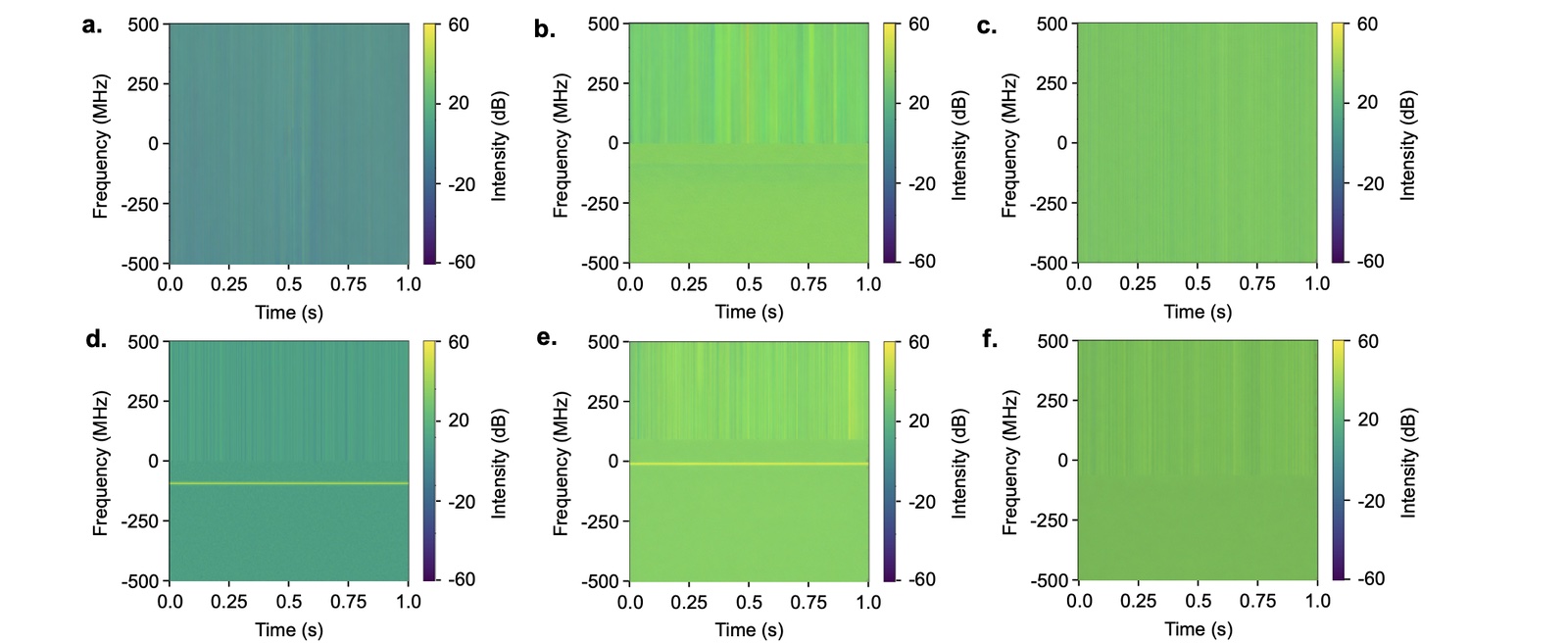
Tested over the air
To check that the model captures real signal structure rather than just color patterns, we converted generated spectrograms back into IQ samples and transmitted them from a third radio, a dedicated jammer, against a live link between two radios. During each 60-second session the jammer was active for only 20 seconds. Even so, the strongest prompt, {tone, high}, raised the average packet error rate to 24.8% and cut the average throughput from 21.3 to 16.0 kB/s, while the mildest, {chirp, low}, produced a 6.8% packet error rate. The interference level named in the prompt translated into a measurable effect on the link.
Why it matters, and what’s next
Synthesizing realistic interference on demand gives us a new way to test and train resilient radios. It builds on our earlier work on mitigating jamming with pattern-reconfigurable antennas and machine learning, and on the lab’s software-defined radio infrastructure, including the Grid SDR Testbed. Next, we plan to integrate retrieval-augmented generation (RAG) so the system can adapt in real time to complex interference patterns and to signal types it hasn’t seen before.
We welcome collaborators and prospective students interested in generative AI for wireless systems. Contact Kapil Dandekar (dandekar ~ drexel.edu).
Team
Matthew Tylek, Keith Truongcao, Md Shakir Hossain, and Kapil R. Dandekar
Publication
M. Tylek, K. Truongcao, M. S. Hossain, and K. R. Dandekar, “Generative AI for Wireless Interference Modeling: Text-Controlled Waveform Synthesis Using Stable Diffusion,” in 2025 IEEE Wireless and Microwave Technology Conference (WAMICON), pp. 1–4, 2025. doi:10.1109/WAMICON64429.2025.11004115
Sponsors
This research was supported by the National Science Foundation (grant CNS-1816387) and Lockheed Martin Advanced Technology Laboratories.