
Wireless systems increasingly have to keep working, and keep people safe, in hostile radio environments: jamming, interference, and high-power directed radio-frequency (RF) energy. DWSL develops antennas, sensors, and learning algorithms that detect, deflect, and withstand these threats.
Detecting dangerous RF exposure
There have been reports of personnel exposed to directed high-energy RF radiation, and accidental exposure can also occur in industrial, manufacturing, and medical settings. Because symptoms may not appear right away, real-time detection matters. We developed what is, to our knowledge, the first energy-harvesting detector for high-energy RF exposure: a small paper dipole antenna feeds a tunable rectifier circuit.
- Reverse-biasing the rectifier’s diode sets its activation threshold, so the sensor responds only to dangerously high power levels.
- Tuning the bias also evens out the rectifier’s frequency-dependent response, so one threshold works across the band (measured from 5 to 10 GHz).
- In normal operation the diode stays off and draws at most 500 nA, which promises long battery life; the parts are small enough for a credit-card-sized sensor.
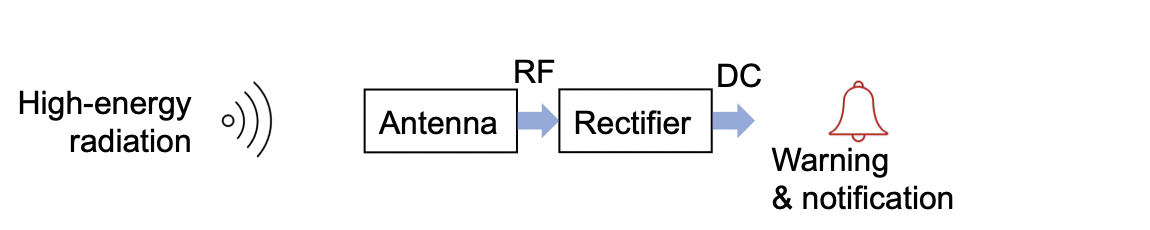
Next, we plan a compact version built from surface-mount components, covering a wider frequency band, evaluated in a wearable form factor.
Deflecting directed RF energy with reconfigurable surfaces
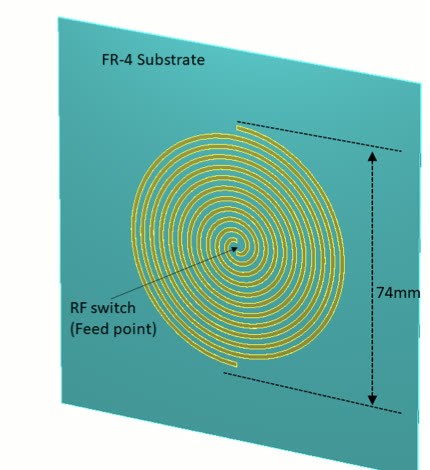
A reconfigurable intelligent surface (RIS) is a large array of electronically switchable elements that can act as a radio-frequency “mirror” or “lens.” We proposed using an RIS to shield people from directed-energy attacks. Our surface is built from spiral antenna elements, which are wideband and circularly polarized, so it can work across a wide range of frequencies regardless of how the incoming waves are polarized: in simulation, the element covers 1.3–7 GHz, with circular polarization from 2 to 7 GHz.
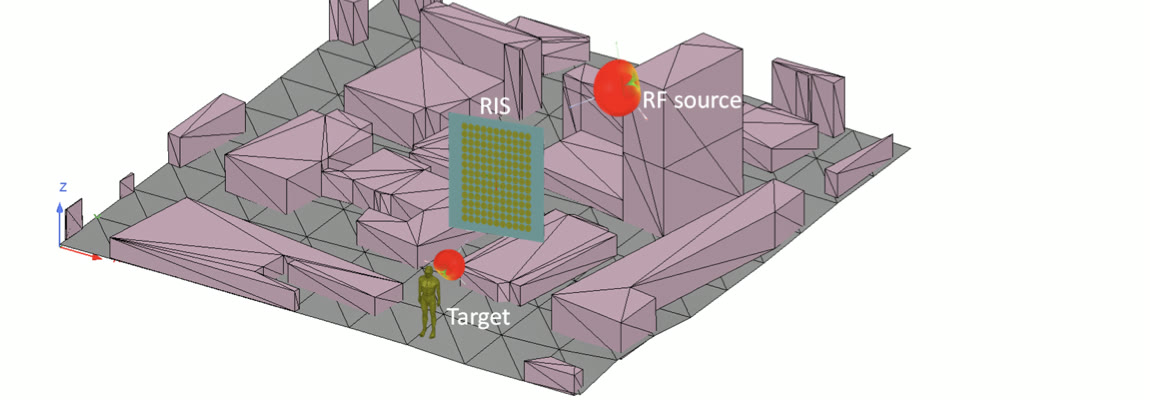
In a full-wave simulation, a 1.2 m × 1.2 m surface of 11 × 13 spiral elements reduced the power received at the person’s location by about 16 dB when its elements were switched on compared with off. These are simulation results; building and testing a prototype is the next step.
Jamming and interference
Jammers can disrupt a link with strong interference. Our earlier work combined pattern-reconfigurable antennas with machine learning to mitigate RF jamming at the physical layer (see Reconfigurable Antennas). Our newest work, Generative AI for Wireless Interference, uses text-controlled diffusion models to synthesize realistic jamming on demand for testing resilient radios.
Team
Kyei Anim, Md Abu Saleh Tajin, Zyad Helali, and Kapil R. Dandekar
Publications
- M. A. S. Tajin, Z. Helali, and K. R. Dandekar, “Directed High-Energy Radio Wave Exposure Detection,” in 2023 IEEE International Symposium on Antennas and Propagation and USNC-URSI Radio Science Meeting, pp. 1107–1108, 2023. doi:10.1109/USNC-URSI52151.2023.10237524
- K. Anim, M. A. S. Tajin, and K. R. Dandekar, “Radio Frequency Directed Energy Weapon Mitigation via Passive Beamforming Reconfigurable Intelligent Surface,” in 2023 IEEE International Symposium on Antennas and Propagation and USNC-URSI Radio Science Meeting, pp. 631–632, 2023. doi:10.1109/USNC-URSI52151.2023.10237947
- M. Jacovic, X. R. Rey, G. Mainland, and K. R. Dandekar, “Mitigating RF Jamming Attacks at the Physical Layer with Machine Learning,” IET Communications, vol. 17, no. 1, pp. 12–28, 2023. doi:10.1049/cmu2.12461
Sponsors
This research was supported by the National Science Foundation (grants CNS-1816387 and ECCS-2034114).