
New wireless ideas have to be proven on real radios, not only in simulation. DWSL builds hardware and testbeds that bring next-generation technologies, such as millimeter-wave beam steering and candidate 6G waveforms, onto real radio hardware where they can be measured repeatably.
Emulating millimeter-wave indoor channels on real radios
Millimeter-wave (mmWave) bands such as 28 GHz promise multi-gigabit data rates, but high path and penetration losses make deep indoor coverage difficult, and real-world mmWave measurements are costly, slow, and hard to repeat. We built a framework that brings realistic, site-specific mmWave channels into the lab:
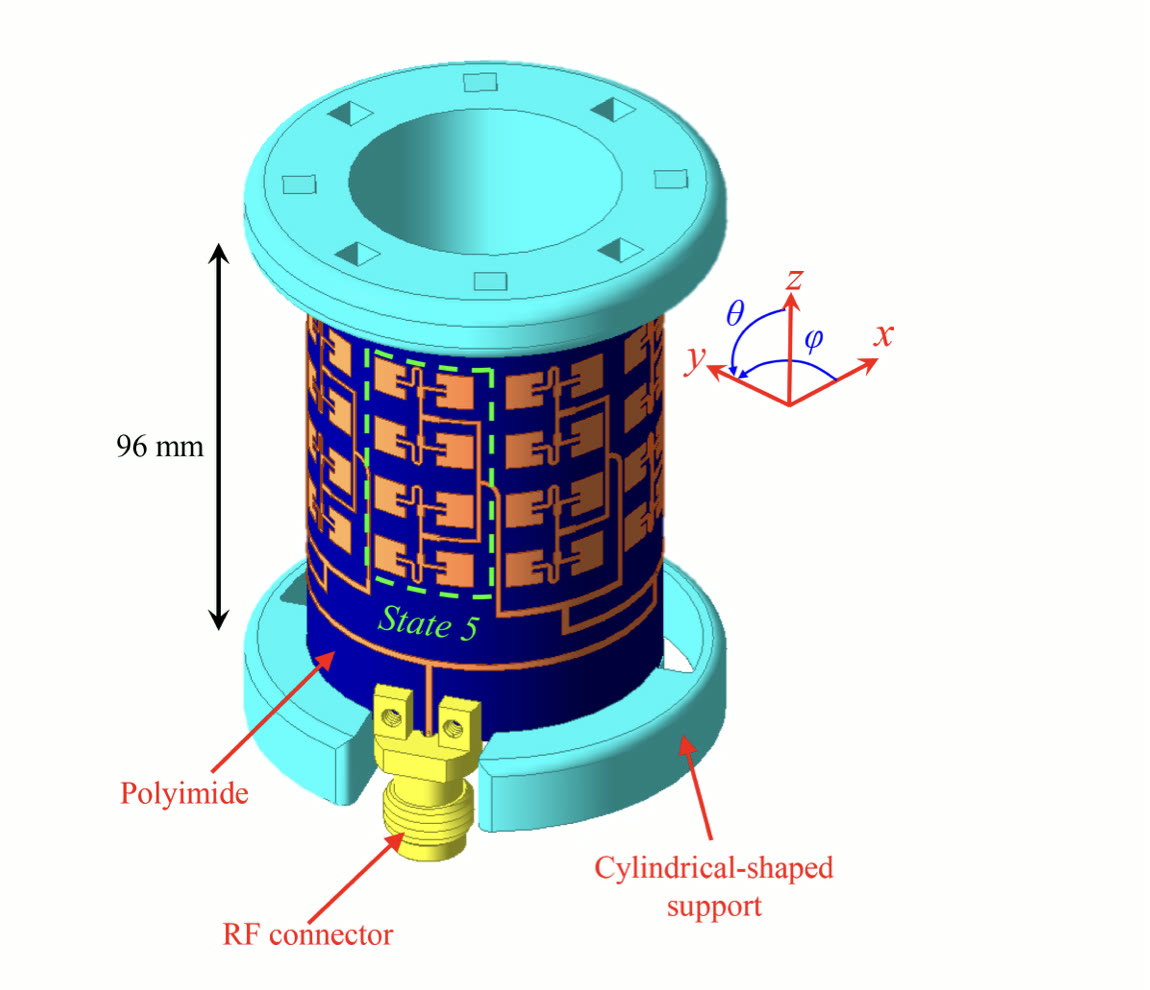
- Antenna: a 28 GHz pattern-reconfigurable cylindrical array printed on flexible polyimide. Eight subarrays form eight beams of about 45° each that together cover all 360°, using a single RF chain, which is simpler and cheaper than a phased array.
- Channels: 3D ray tracing of a 17 m × 18 m office with a moving user, reduced to the three most significant paths with a clustering method that preserves the channel’s delay and angular spread.
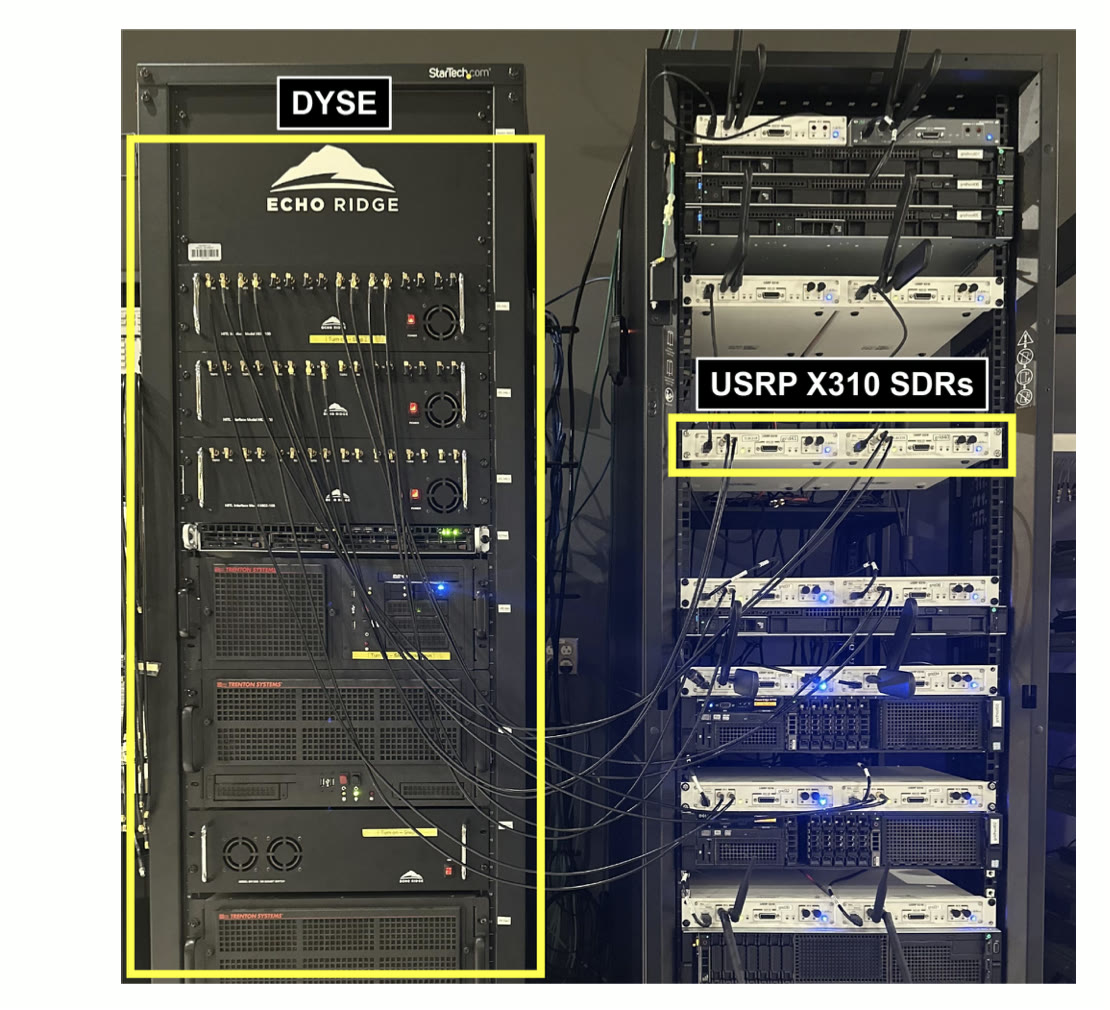
- Emulation: the Grid testbed‘s DYSE channel emulator plays these channels back in real time between USRP X310 radios running DragonRadio, so experiments are repeatable with real hardware in the loop.
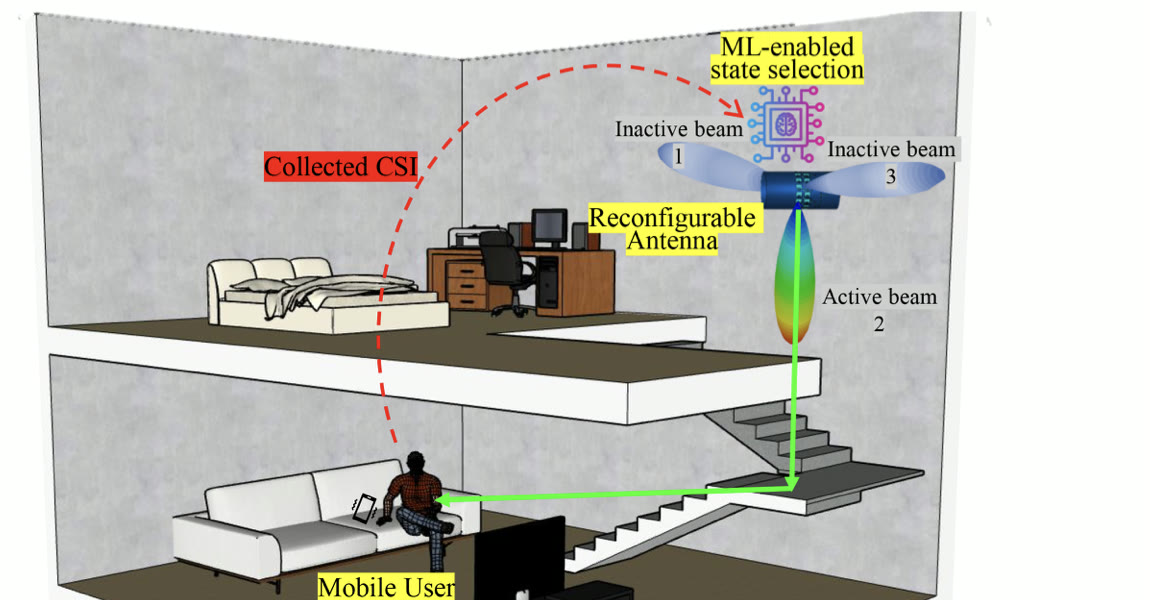
Learning-based beam selection made the difference. Thompson Sampling and UCB1-Tuned gave the highest throughput and lowest packet error rates, and kept links reliable at high modulation orders, where a fixed omnidirectional antenna lost 87% of packets (QAM-64). Next, we plan to extend the framework to multi-user MIMO and to low-latency machine learning for real-time adaptation.
6G waveforms on FPGA hardware
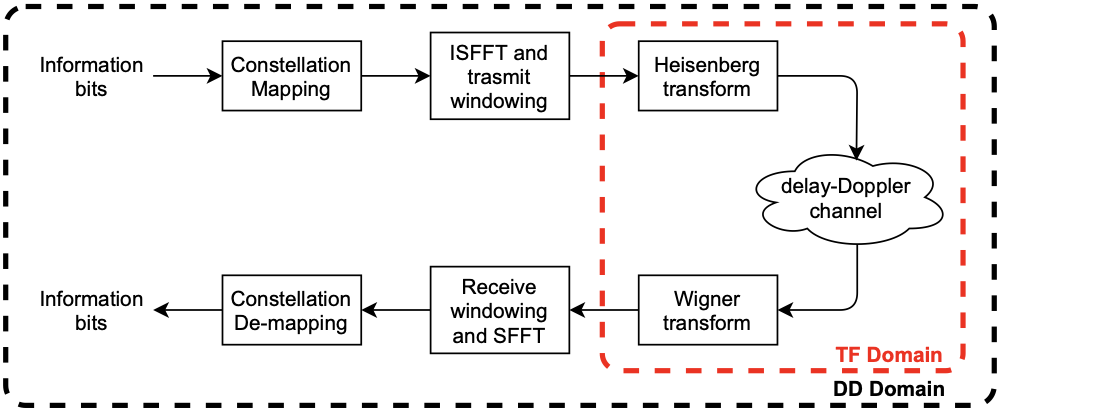
Orthogonal time frequency space (OTFS) modulation places data in the delay-Doppler domain, which makes it robust to the large Doppler shifts of fast-moving users, such as high-speed trains, drones, and vehicles, where today’s OFDM degrades. Most OTFS work so far has been theoretical or simulated. We implemented a complete OTFS transmitter and receiver chain on a Xilinx Zynq UltraScale+ RFSoC FPGA and verified it against MATLAB. The design uses under 1% of the device’s logic, consumes 1.45 W, and has a latency of 12.17 µs. Next, we plan to add an RF front end on a USRP X410, which uses the same FPGA family, for over-the-air experiments.
See also: Grid Software Defined Radio Testbed, mmWave SDR Testbed, and Millimeter Wave Antenna Design.
Team
Md Shakir Hossain, Kyei Anim, Geoffrey Mainland, Murat Isik, Malvin Nkomo, Anup Das, and Kapil R. Dandekar
Publications
- M. S. Hossain, K. Anim, G. Mainland, and K. R. Dandekar, “Toward Realistic SDR-Based Emulation of Ray-Traced Millimeter-Wave Indoor Channels for Next-Generation Wireless Systems,” IEEE Journal of Radio Frequency Identification, vol. 9, pp. 490–504, 2025. doi:10.1109/JRFID.2025.3586561
- M. Isik, M. Nkomo, A. Das, and K. R. Dandekar, “FPGA Implementation of OTFS Modulation for 6G Communication Systems,” in 2023 IEEE Future Networks World Forum (FNWF), pp. 1–7, 2023. doi:10.1109/FNWF58287.2023.10520425
Sponsors
This research was supported by the National Science Foundation (grants CNS-1816387 and CNS-1828236).