
Radio waves can sense as well as communicate. DWSL develops battery-free, low-cost radio-frequency sensors, built from RFID tags and conductive fabrics, that can monitor patients and medical equipment without wires, batteries, or cameras.
Battery-free IV fluid monitoring
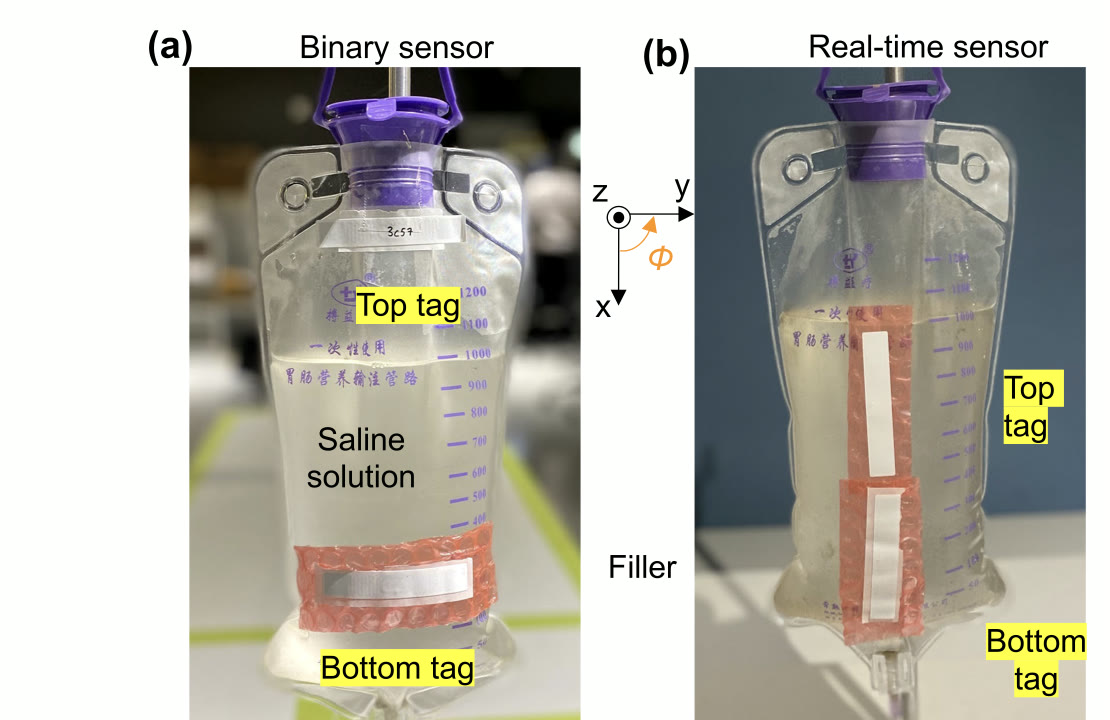
When an intravenous (IV) bag runs dry and is not replaced promptly, blood can flow back into the line, so caregivers must check each bag by hand. We developed IV fluid level sensors from two commercial, passive UHF RFID paper tags attached to the bag. The fluid near each tag changes the tag antenna’s gain and impedance, and so the signal strength the RFID reader sees.
- Binary sensor: a reliable full/empty alarm. A reference tag and a spacer keep both tags readable at all times, which removes the uncertainty of single-tag designs.
- Real-time sensor: tracks the fluid level continuously. Machine-learning models (a generalized additive model and a random forest) estimate the level every 2 seconds; depending on the reader angle, 72–97% (GAM) and 62–98% (random forest) of estimates fell within 20% of the true level.
- Battery-free, lightweight, and low-cost, with a 4.6 m read range, and it works over a 150° span of reader angles. To our knowledge, it is the first passive RFID real-time saline level sensor that uses machine learning.
Wearable and smart-fabric sensing
With the Drexel Center for Functional Fabrics, DWSL develops knitted RF sensors and antennas that turn clothing into medical sensors; see Biomedical Smart Textiles and Functional Fabrics for the Internet of Things. Our high-energy RF exposure detector is also being developed for a wearable form factor.
Team
Md Abu Saleh Tajin, Md Shakir Hossain, William M. Mongan (Ursinus College), and Kapil R. Dandekar
Publication
M. A. S. Tajin, M. S. Hossain, W. M. Mongan, and K. R. Dandekar, “Passive UHF RFID-Based Real-Time Intravenous Fluid Level Sensor,” IEEE Sensors Journal, vol. 24, no. 3, pp. 3863–3873, 2024. doi:10.1109/JSEN.2023.3342129
Sponsors
This research was supported by the National Science Foundation (grant CNS-1816387) and the National Institutes of Health (grant R01 EB029364).